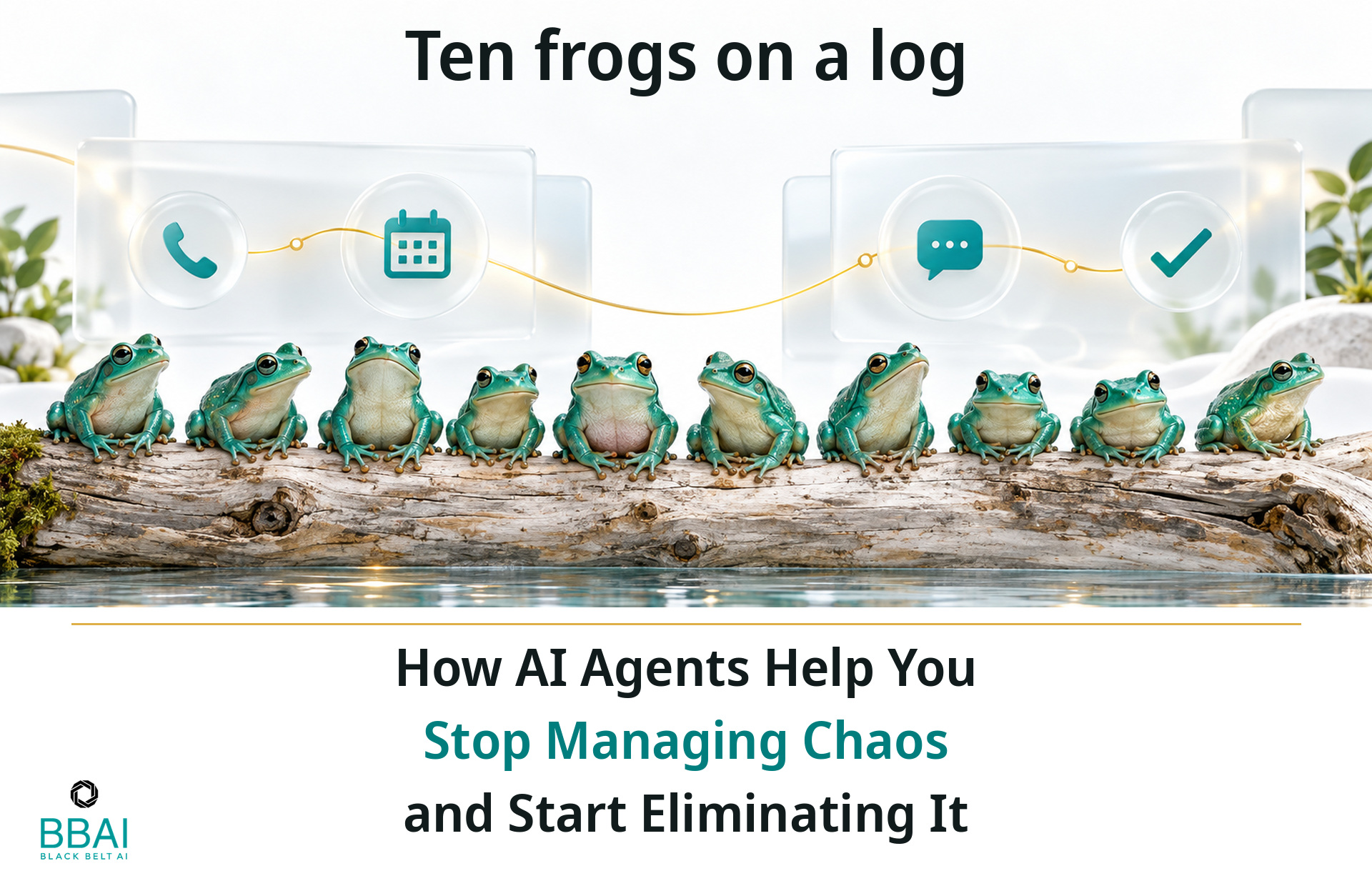
Ten frogs are sitting on a log. Two decide to jump into the water. How many are left on the log?
Ten. Deciding to jump and actually jumping are two different things.
That riddle opens a keynote by simplicity expert Lisa Bodell, founder of futurethink and author of Why Simple Wins, and it's stuck with us ever since. Her talk was aimed at leaders in big, regulated organizations, but every small-business owner we work with will recognize themselves in it: working incredibly hard, carrying a lot, and quietly feeling that all that effort should add up to more.
Bodell's answer isn't a better to-do list. It's permission to question the work itself. Our angle is the practical follow-up: once you've decided what to cut, how do technology, automation, and AI Agents help you actually jump off the log?
It's not you. It's the work.
Bodell tells a story about calling her babysitter late one night from the office, and the babysitter answering before she could say a word: "Let me guess. You need one more hour." She was organized. She color-coded. It didn't matter, because no calendar system can spreadsheet you out of work that shouldn't exist.
The research backs her up. Asana's Anatomy of Work Index found that knowledge workers spend about 60% of their time on "work about work": chasing updates, sitting in status meetings, searching for information, and switching between apps. Microsoft's 2025 Work Trend Index found that the most pinged 20% of Microsoft 365 users received an interruption about every two minutes during core work hours, with roughly 275 pings across a full 24-hour day. Bain & Company has a name for this: "organizational drag," the institutional friction that quietly eats a company's productive capacity.
For a small business, drag looks different but feels the same. It's the phone ringing while you're with a customer. It's the web form that sat unanswered all weekend. It's retyping the same lead's details into three different places. None of it is anyone's fault. All of it is structural.
Here's how Bodell's four mindset shifts translate when you bring technology into the picture.
Shift 1: From organized to simplified
"Organized means managing chaos," Bodell says. "Simplified means eliminating it."
This may be the most important distinction in any conversation about AI, because most businesses use technology to get more organized: another app, another dashboard, another inbox to check. That's just nicer storage for the same clutter.
Good automation removes steps entirely. Think about a missed call. The organized approach is a voicemail box and a sticky note reminding you to call back. The simplified approach is an AI receptionist that answers, captures what the caller needs, books the appointment, and logs the details in your CRM, so there's no callback to remember at all.
The test we use with clients borrows Bodell's Marie Kondo analogy: does this step add value for the customer? If not, the goal isn't to organize it. It's to make it disappear.
Shift 2: From addition to subtraction
Most of us got where we are by adding: more clients, more services, more tools. Bodell wants leaders to act like sculptors instead of builders, chiseling away until what's left is what matters.
Here's where we have to be honest about our own industry: automation is an addition. Bolt AI onto a messy process and you get a faster mess.
So subtract first. Bodell's signature exercise, "Kill a Stupid Rule," asks a team which rules they'd eliminate if they could. Most of what surfaces aren't real rules at all. They're habits and assumptions nobody has questioned in years. (In regulated work, compliance requirements stay put. Bodell is clear that the target is the everyday stuff inside your control, not the law.)
Run that exercise before you automate anything. Does a manager really need to approve every small quote? Does every inquiry need a phone call, or would most customers happily book online? Once you've cut what doesn't need to exist, automate what's left. That order matters more than which tool you pick.
Shift 3: From reactive to intentional
"If you don't take control of your time," Bodell warns, "complexity will take control of it for you." Most of us don't lead our day. We execute our calendar and react to whatever pings next.
For small businesses, the biggest source of reactive work is the front door: calls, texts, form fills, and DMs that all want an answer right now. And speed really does matter. In the Harvard Business Review study "The Short Life of Online Sales Leads," firms that responded to an inquiry within an hour were nearly seven times as likely to qualify the lead as firms that waited even an hour longer. Yet only 37% of the companies audited responded within an hour, and 23% never responded at all.
That leaves owners in an impossible spot: drop everything for every ping and never focus, or protect your focus and lose the lead.
AI Agents break that trade-off. A webchat agent answers questions on your site at 11 p.m. An SMS agent texts a new lead back within moments and offers times to book. A voice agent handles routine calls and routes the important ones to you. Customers get a fast, friendly response, and you get to batch your attention instead of having it chopped into two-minute pieces.
Bodell also loves Kickstarter's idea of "time crime": treating it as a real offense to waste someone else's time. Done right, automation is a time-crime prevention program for your team and your customers alike.
Shift 4: From doing to thinking
Ask people where they do their best thinking, Bodell says, and you'll hear the shower, the car, a quiet walk. Almost nobody says "in a meeting." We get our best ideas alone and build them together, but only if there's time to think in the first place.
This is the real payoff of automation, and it's why we don't pitch AI as a productivity hack. As Bodell points out, people will work all night if they believe the work is meaningful. The point isn't squeezing out more output. It's handing people back the hours for work that matters.
When AI handles the appointment reminders, review requests, follow-up texts, and check-ins with past customers, your team gets time back for what you actually hired them to do: solve problems, care for customers, and think about where the business goes next. That's what we mean by Enhancing the Human Connection. The technology handles the repetitive; the humans handle the relationships.
A caution: AI can make the "infinite workday" worse
It would be easy to write a blog that says "add AI and your problems vanish." But Microsoft's own researchers warn that AI could deepen the infinite workday if it's simply layered on top of the old way of working: more drafts, more messages, more noise.
That's why the subtraction step isn't optional. AI that generates more email is complexity in a nicer outfit. AI that removes the need for the email is simplicity.
A few rules of thumb we follow:
- Automate decisions you've already made, not decisions you're avoiding.
- Measure success in time returned to people, not tasks completed by software.
- Keep a human clearly in the loop for anything sensitive, judgment-heavy, or regulated.
- Pilot first. As Bodell notes, people resist a lot less when a change feels like an experiment.
Jump off the log
Bodell's closing advice is the right place to end: don't try to do everything. Do one thing. Your team is waiting for you to go first and prove the sky doesn't fall.
So pick one. Maybe it's killing a stupid rule at your next team meeting. Maybe it's finally answering missed calls automatically. Maybe it's blocking half a day a week for deep work while an AI Agent covers the front door.
Complexity is a choice; somebody built it. Simplicity is a choice, too. Deciding to jump is the easy part. Let's get you in the water.
Ready to find your first jump? Book a strategy call with Black Belt AI. We'll help you spot the one process worth simplifying first, and tell you honestly whether automation is even the right answer.
Sources
- Lisa Bodell, Why Simple Wins (Routledge, 2016)
- Lisa Bodell, "Kill A Stupid Rule", Leading Authorities
- Asana, "Why work about work is bad" (Anatomy of Work Index)
- Microsoft WorkLab, "Breaking Down the Infinite Workday" (2025 Work Trend Index)
- GeekWire, "The infinite workday is here, and Microsoft says AI will make it worse if we're not careful"
- Bain & Company, Time, Talent, Energy
- Oldroyd, McElheran & Elkington, "The Short Life of Online Sales Leads", Harvard Business Review, 2011